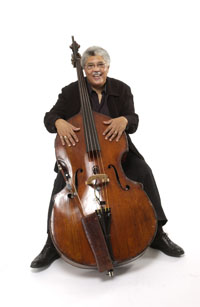
“He was amazing. Duke Ellington’s band came through St. Louis and played a dance—back then it was dances and not concerts. Afterward Duke went back to the hotel to sleep, and all the musicians went to an after-hours session. This young bass player was playing, and these guys flipped out. They went back and woke up Duke Ellington, and brought him to the session. Duke hired Jimmy on the spot, and the band left St. Louis with two bass players. Jimmy Blanton made all those records in 1940 and ’41, and then he got what they called “consumption” back then, tuberculosis. He got very sick in L.A. and they had to leave him in a sanitarium. He had no family there; he was by himself in a little isolated cabin. Milt Hinton told me he went there every day to see him. Milt was playing in Cab Calloway’s band at that time, and every night they’d dedicate a song to him. Milt said he was there when Jimmy took his last breath. He was 23 years old. But if you’ve ever heard him play … man!”
“Quest for an Acoustic Bass Amp”
The november issue of the Premier Guitar magazine features an article by Dan Berkowitz about searching for a rig that could double nicely for both electric and double bass: “Quest for an Acoustic Bass Amp”.
Internationale Johann-Matthias-Sperger-Gesellschaft
The Johann-Matthias-Sperger Gesellschaft (Johann-Matthias-Sperger Society) has launched their new website: www.spergergesellschaft.de.
Besides articles about composer and bassist Johann Matthias Sperger, the website features informations about the Sperger-Wettbewerb (double bass contest). The next Sperger-Wettbewerb will take place from Sept., 29 to Oct., 5. 2008 at Ludwigslust (near Schwerin, North-Eastern Germany)
Being a Bassist and more
Bassist Rufus Reid has written an article on “Being a Bassist” for the magazine All About Jazz – New York:
“The bassist of any group or ensemble is the core, the foundation, the ‘rock’, one who stabilizes the unit when it becomes shaky and the individual that everyone depends on dearly ‘to always be there!’ (…) All members in the group desire a positive, confident and consistent posture by the bassist. The desired musician has what everyone wants and needs to make the ensemble the best. Let’s explore the necessary aspects that will make you that desired bassist.”
You can download PDF of the current issue (that also feautures an interview with bassist Larry Ridley) at the magazine’s website for free.
Quote: Interview with Charlie Haden and Flea
Flea: The most incredible thing about the upright bass—the few times I’ve played one—is the way you can feel the whole thing vibrate when you have it up against your body. It’s like your body is resonating with the instrument. It’s a very fulfilling feeling.
Haden: It is! That’s why I stand so close to the instrument when I play. I put my head next to it. One night in 1959 I was playing at the Five Spot with Ornette, Don Cherry, and Billy Higgins, and I always play with my eyes closed—but I opened my eyes, and there was some guy onstage with his ear next to my ƒ-hole. And I was like, “Who is this guy?” And Ornette was like, “That’s Leonard Bernstein!” And I was like, “Okay . . . .”